There’s a moment that shows up in a lot of businesses.
Work is happening. Tasks are getting checked off. From the outside, it looks like progress. Even internally, the team feels productive.
Yet something doesn’t add up.
Deadlines move. Clients ask for clarity. Or you step back and realize that despite all the activity, you’re not actually closer to the outcome.
This is where a different kind of breakdown starts to show up.
- Not in alignment.
- Not in communication.
- Not in effort.
In execution itself.
This is what I call a process leak.
If you’ve been following the earlier Trust Leaks™ episodes, we’ve already looked at how trust breaks through misalignment, unclear expectations, ownership gaps, and communication breakdowns.
This episode builds on that foundation.
Because even when all of those are working…
Execution can still fail.
A process leak isn’t the absence of a process. In many cases, the process exists and is being followed exactly as designed. The team is doing their part. Steps are completed. Tasks are checked off.
And still, the intended result doesn’t happen.
That’s what makes process leaks so difficult to detect.
On the surface, everything appears to be working.
One of the biggest traps in growing businesses is confusing motion with movement. Activity increases, yet meaningful progress stalls.
The presence of structure creates a sense of confidence, even when that structure is no longer producing the outcome it was designed for.
Most processes don’t start broken. They drift.
They were created at a different stage of the business, often with different people and different constraints. Over time, small adjustments are made. Steps are added. Workarounds become normalized.
Eventually, the process being followed no longer matches the reality it was meant to support.
This is also where process leaks begin to overlap with ownership leaks.
Individuals are responsible for their piece of the process, yet no one is accountable for the final outcome.
If you’ve seen this pattern before, it connects directly to the earlier breakdown we discussed around ownership — where work moves forward, yet results stall because no one is truly holding the full outcome.
A simple example is client onboarding.
The intake form is completed. The welcome email is sent. Files are shared. Every step in the process is executed.
Yet the client is still unclear.
Questions come in that should have already been answered. Confidence is lower than expected. The experience feels incomplete.
The process happened. The outcome didn’t.
This is where the shift needs to happen.
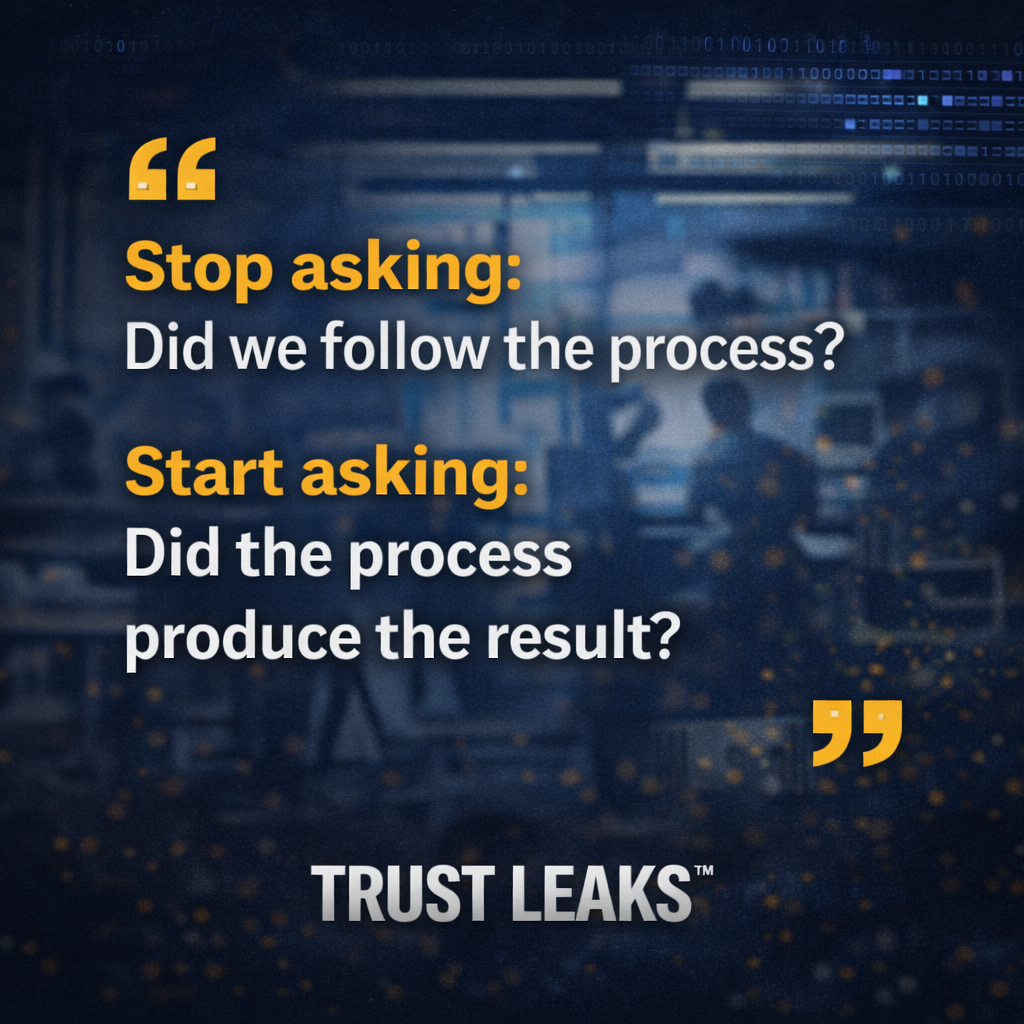
Instead of asking, “Did we follow the process?” the better question is:
“Did the process produce the intended result?”
This reframing removes blame and creates clarity. It allows teams to evaluate the effectiveness of their systems instead of simply confirming compliance.
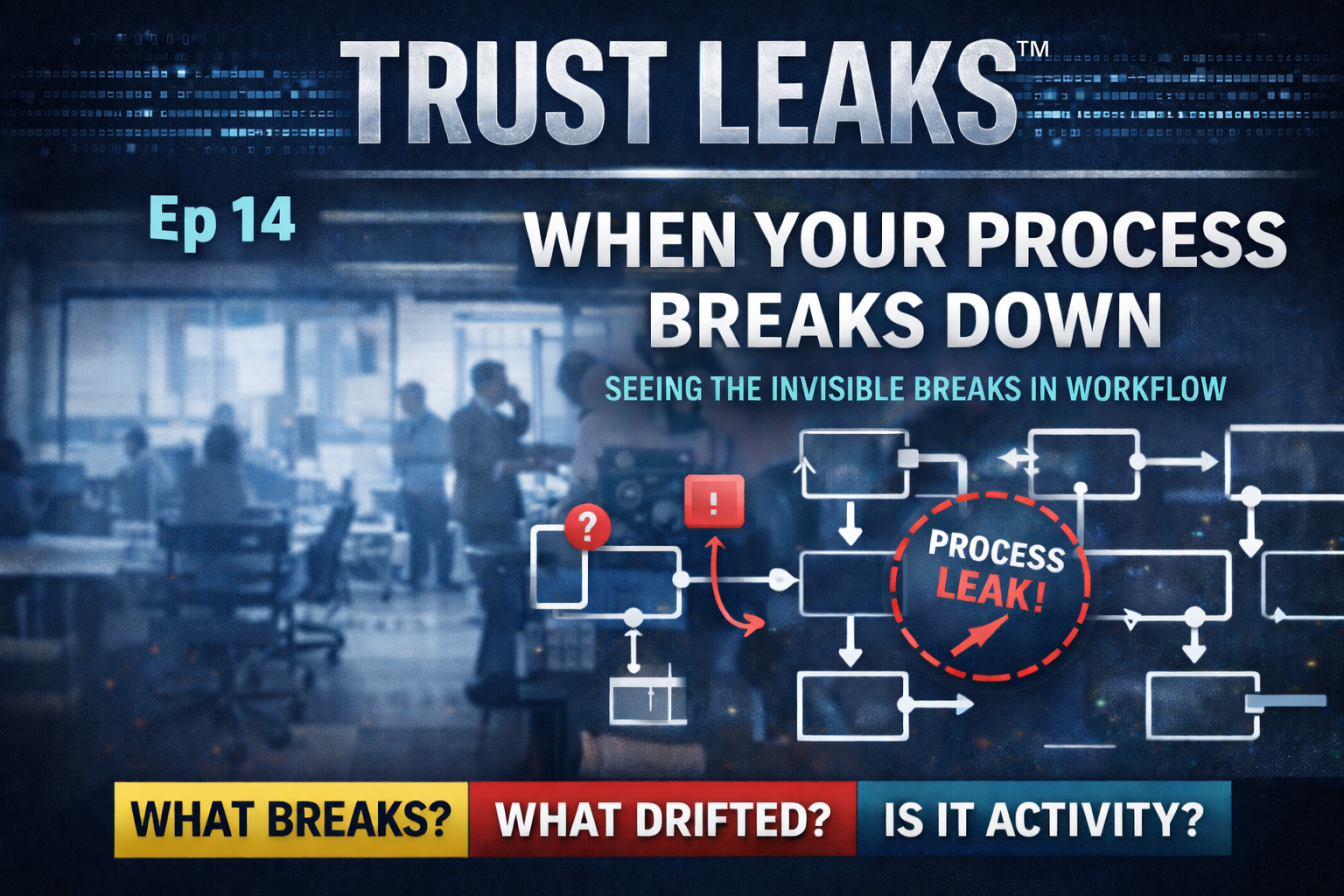
If you want to identify process leaks inside your business, start with three questions:
What outcome is this process supposed to create?
Where did it break or drift?
Where are we mistaking activity for progress?
These questions are simple, yet they often reveal the root of the issue quickly.
Because when a process leaks, the impact is rarely immediate or obvious.
- Clients feel uncertainty
- Teams lose confidence
- Timelines slip
And even when no one has made a mistake, trust begins to erode.
Process leaks don’t look like failure.
They look like progress.
Until you realize the result isn’t there.
Listen to the Full Episode
To hear the full discussion, listen to Trust Leaks™️ Podcast – Episode 14: Process Leaks: When the Work Moves but the System Doesn’t on Apple, Spotify or YouTube.
Continue the Trust Leaks™ series:
- Alignment leaks (when teams aren’t truly aligned)
- Expectation leaks (when clarity is assumed, not confirmed)
- Ownership leaks (when no one owns the outcome)
- Communication leaks (when information doesn’t land clearly)