
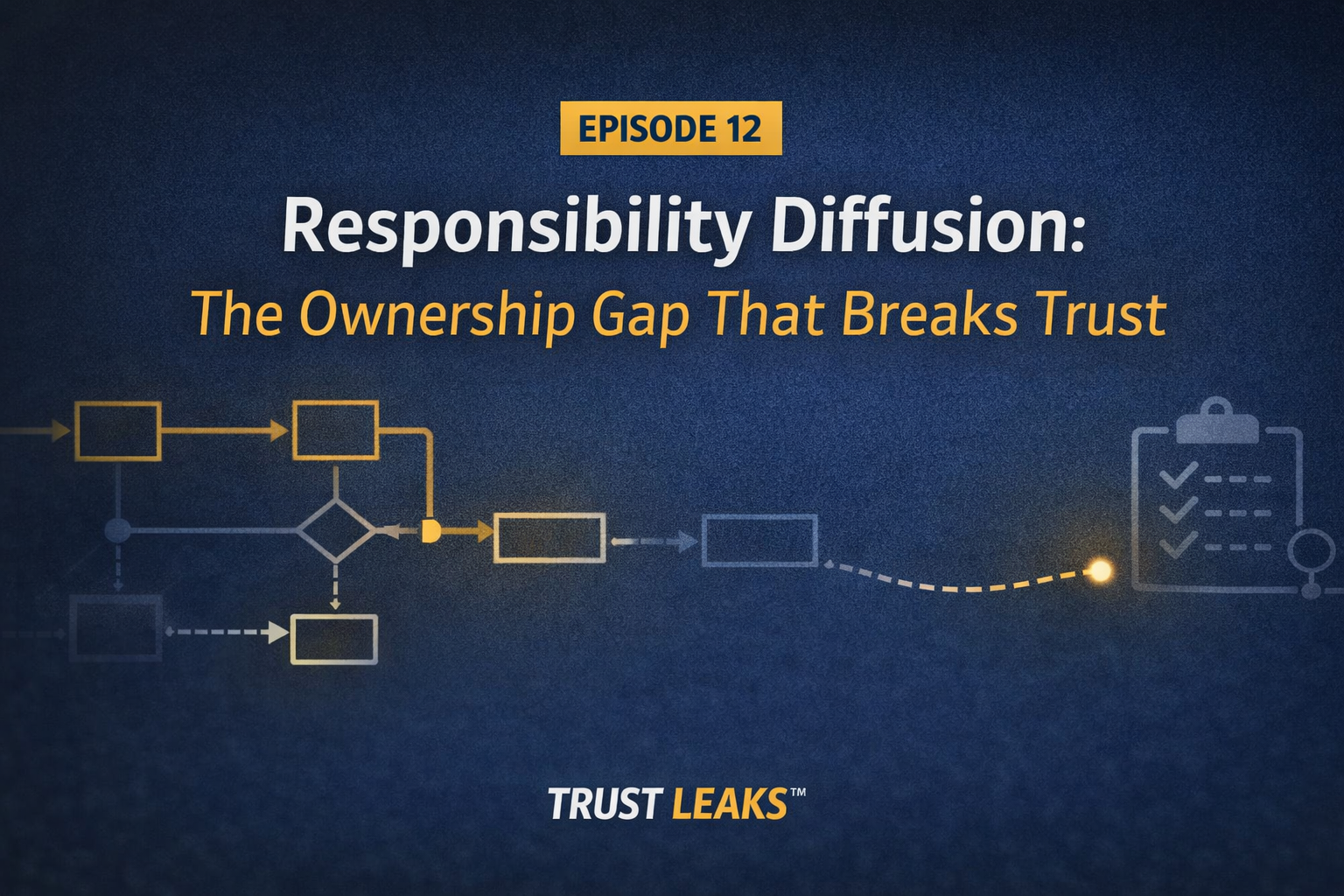
Responsibility diffusion in business occurs when multiple people or systems are involved in a task, but no single person is clearly accountable — leading to missed follow-ups, unclear handoffs, and a gradual breakdown in trust.
The Moment It Starts (And Why It’s Easy to Miss)
There’s a moment that shows up in almost every growing business.
Something small slips. A follow-up email isn’t sent. A client question sits unanswered. A detail gets overlooked.
At first glance, it’s minor.
Until you ask what happened—and hear:
“I thought someone else had it.”
This is where responsibility diffusion begins. And while the issue itself may be small, the underlying problem is not.
Because if no one owned this… what else isn’t being owned?
What Responsibility Diffusion Really Looks Like
Responsibility diffusion doesn’t show up as chaos. It shows up as quiet gaps:
- Tasks that move halfway through a process and stall
- Internal handoffs that are implied, not defined
- Team members waiting instead of acting
- Systems holding overlapping or conflicting data
- Work that exists “between” roles instead of within them
From the inside, everyone feels busy. Productive, even.
From the outside, it feels like no one is fully on top of things.
That gap between effort and perception?
That’s where trust starts to erode.
Why It Happens (Even in Good Teams)
Responsibility diffusion isn’t a people problem—it’s a clarity problem.
It tends to show up when:
- Roles are loosely defined
- Ownership isn’t assigned at the task level
- Leaders assume clarity instead of confirming it
- Growth outpaces structure
- Collaboration increases without guardrails
Collaboration is valuable—but without clarity, it creates gaps.
And gaps are where things fall through.
The Leadership Trap Most Teams Fall Into
There’s a common assumption in growing businesses:
“If everyone is involved, it’s covered.”
But involvement is not ownership.
When multiple people are “involved,” responsibility often becomes diluted instead of strengthened.
And without a single owner, accountability disappears.
The One Question That Fixes It
There’s a simple way to prevent responsibility diffusion:
Who owns this from start to finish?
Not “who’s helping.”
Not “who touched it.”
Not “who’s aware of it.”
Who owns it?
Once that’s clear, the rest becomes straightforward:
- Assign it
- Communicate it
- Confirm it
Clarity removes friction before it ever shows up.
Practical Takeaways You Can Apply Immediately
- Assign one owner to every task—no exceptions
- Define ownership at the task level, not just project level
- Make handoffs explicit, not assumed
- Identify a single “source of truth” for each system
- Build a habit of confirming ownership in meetings and workflows
- Watch for “waiting behavior”—it’s often a sign of unclear ownership
Where Else This Shows Up (Related Trust Leaks™ to Explore)
If you’re seeing signs of responsibility diffusion, you may also want to examine:
- Decision Latency — when unclear ownership slows decisions
- Process Leaks — when workflows break between steps
- Ownership Leaks — when accountability is assumed instead of assigned
These often show up together and compound over time.
Listen to the Full Episode
To hear the full discussion, listen to Trust Leaks™️ Podcast – Episode 12: Responsibility Diffusion: The Ownership Gap That’s Costing You Trust on Apple, Spotify or YouTube.
Closing Thought
Businesses don’t lose trust because people don’t care.
They lose trust because no one is clearly responsible.
Clarity protects trust—at every level of your business.