Most business owners assume trust breaks when something obvious goes wrong — a missed email, a dropped ball, a major service failure. When clients leave, leaders often look for a clear moment where everything unraveled.
But in reality, trust rarely breaks in one loud moment.
It erodes quietly, after the experience begins.
Once someone becomes a client, they don’t just receive deliverables. They move through transitions: from prospect to customer, from excitement to uncertainty, from clarity to confusion. And it’s inside those transitions — especially the ones we don’t intentionally design — that the most expensive trust leaks occur.
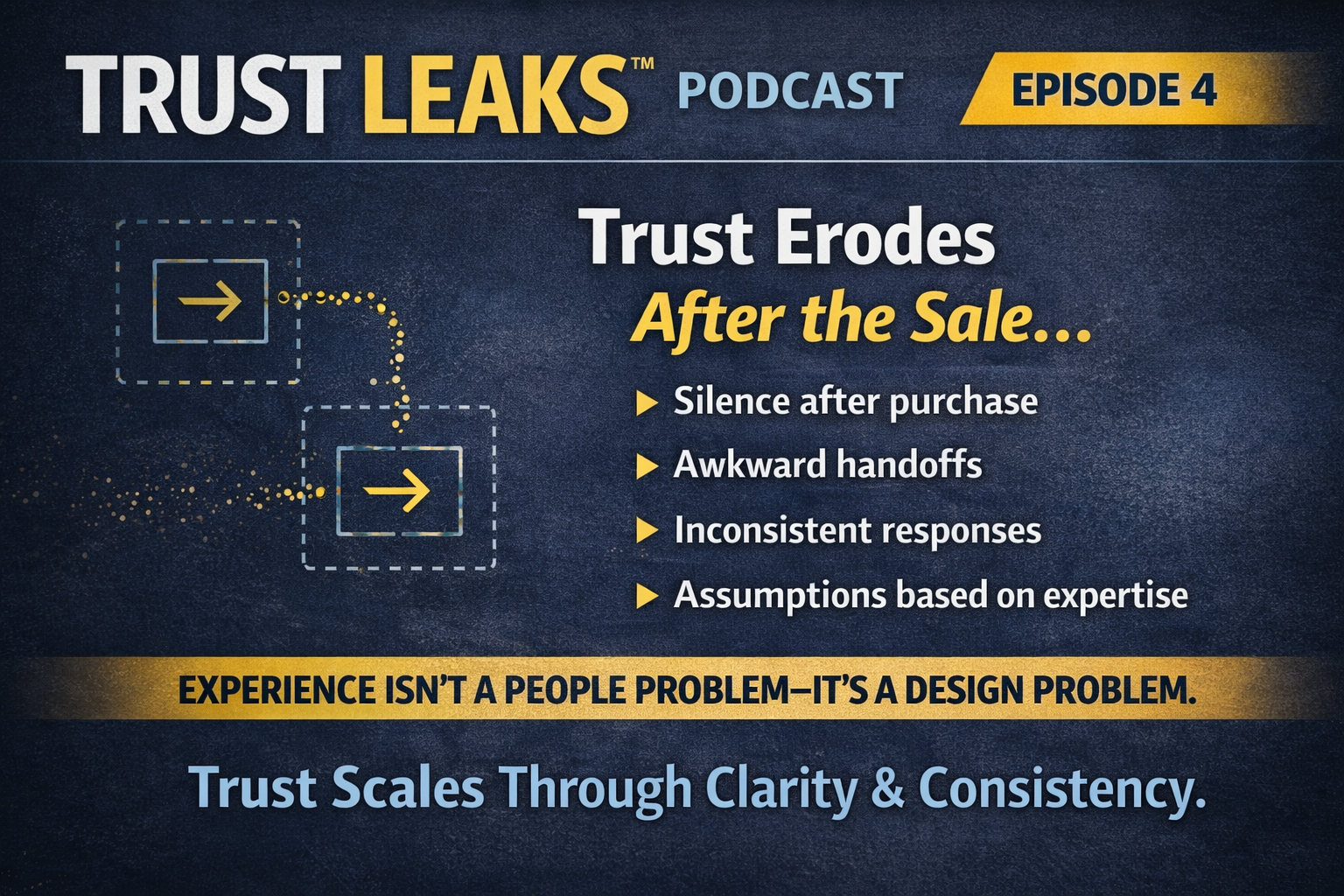
In Episode 4 of the Trust Leaks™ podcast, I break down four hidden experience gaps that cause clients to disengage and churn without ever complaining.
The first is the “Now What?” gap. A client says yes, pays, receives a welcome message — and then nothing. Silence creates uncertainty, not confidence. Even a short delay without clear next steps can trigger doubt about whether the client truly matters.
Next is the energy drop gap. When your presence, responsiveness, or tone shifts significantly after the sale, clients subconsciously question their decision. Trust is built through steadiness, not hype. Consistent energy signals safety.
The third gap is the assumption gap. Expertise creates blind spots. What feels obvious to you may be unclear — or completely invisible — to your client. When assumptions replace clarity, confusion fills the space.
Finally, the inconsistency gap. Different answers on different days. Support that varies by who responds. Presence that depends on mood or workload. Clients don’t expect perfection — they expect predictability.
What makes these gaps so costly is that clients rarely complain about them. Most people are conflict-avoidant. They internalize friction, disengage quietly, and eventually leave.
This doesn’t mean you’re bad at what you do. It means experience is a design problem, not a people problem.
Trust doesn’t scale through effort. It scales through clear transitions, explicit expectations, and systems that remove guesswork.
When experience is designed well, clients feel supported — without you having to constantly prove yourself.
Check out Episode 3, The 4-Step Trust Leak Discovery Scan here.
About the Podcast
Trust Leaks™ with Sandra Martini helps small business owners identify and fix the hidden issues draining revenue, retention, and referrals using clear systems and Extreme Client Care™.
Listen on Your Favorite Platform
Apple Podcasts
Spotify
Audible
Amazon Music
YouTube® Playlist