Most businesses don’t struggle because their strategy is flawed.
They struggle because good decisions don’t fully land.
A change gets decided.
An improvement gets discussed.
A direction gets agreed on — at least in principle.
And then… things move on.
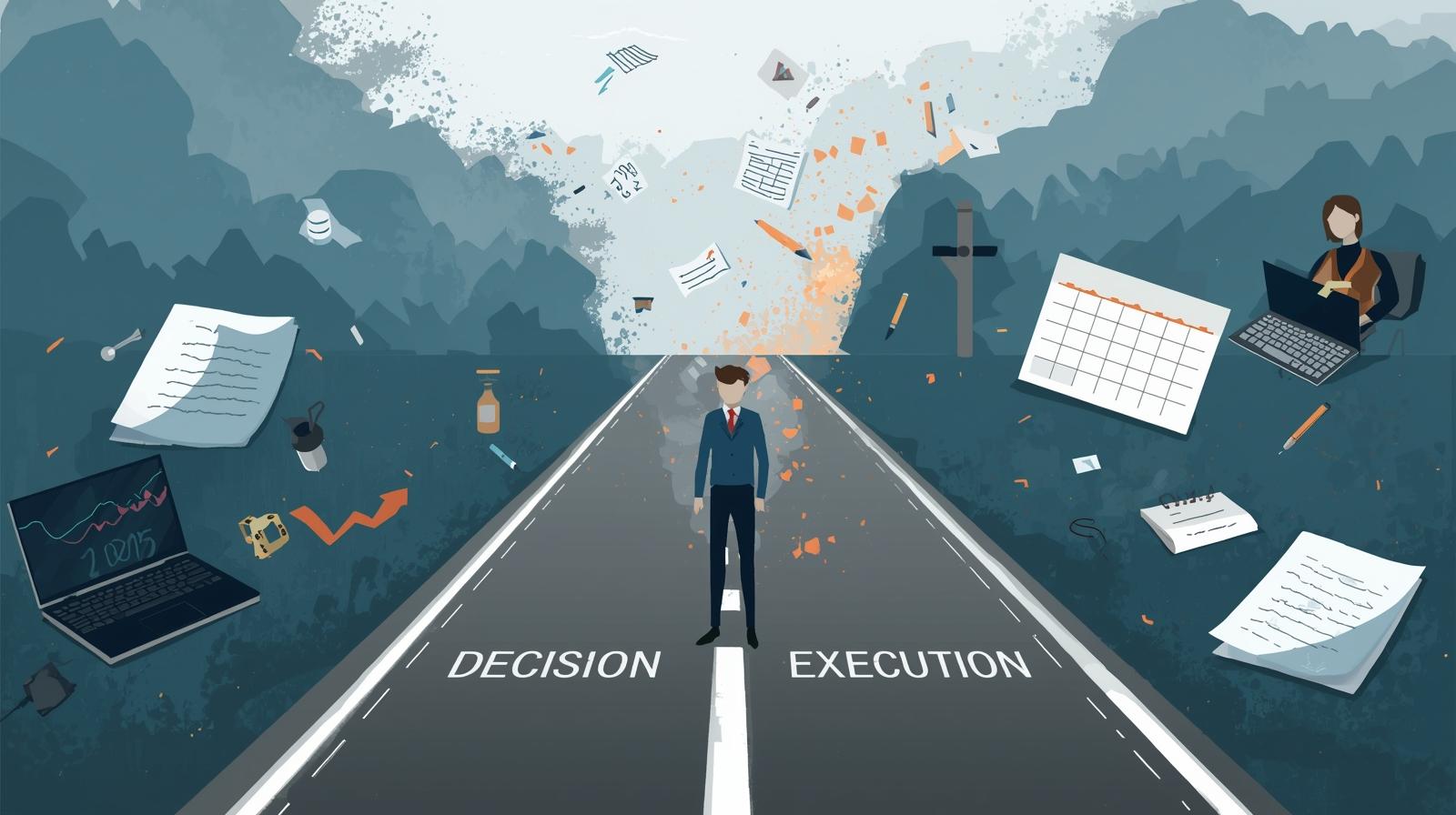
The problem isn’t the decision itself. It’s what happens in the space after it.
That space is where assumptions creep in.
You assume you’ll remember to follow up.
You assume the next step is obvious.
You assume it will get handled when there’s time.
But assumptions don’t create momentum. They create gaps.
Those gaps rarely announce themselves as problems. Instead, they show up as friction:
- Things feel heavier than they should
- Progress feels slower than expected
- You revisit the same topics over and over
- You feel busy, but not cleanly moving forward
This is especially common in businesses that are already “working.”
There’s revenue.
There are clients.
There’s activity.
Which makes it easy to miss the real issue.
Strategy doesn’t fall apart because it’s wrong.
It falls apart because decisions don’t have a clear place to land.
That landing place might be:
- A documented next step
- A calendar commitment
- A named owner (even if that owner is future-you)
- A system that reinforces the decision automatically
Without that, decisions live in your head — and nowhere else.
And heads are busy places.
This isn’t a solopreneur problem. It’s not a team problem either.
It’s a structure problem.
Whether you’re working alone, with contractors, or with a team, decisions need somewhere to go. Otherwise, they dissolve into “we’ll circle back” territory.
Over time, those unresolved micro-decisions stack up.
Not enough to break the business.
Just enough to slow it down.
The businesses that feel steady and decisive aren’t chasing better ideas.
They’re reducing the distance between a decision and the moment it becomes real.
They give decisions somewhere to live beyond memory — in calendars, systems, ownership, and habits that don’t require constant rethinking.
Over time, that’s what creates momentum that actually holds.
Not urgency. Not pressure.
Just clarity that survives the day it was decided.