What Would Sandy Do? Why Not All Owner Dependency Is Bad
Years ago, one of my clients had a Post-it note on her desk that said:
WWSD
“What would Sandy do?”
I hadn’t thought about it in a while until I read an email about AI that immediately made me think of WWSD.
She Wasn’t Trying to Remember a Rule
My client didn’t keep that Post-it on her desk because she was trying to remember one of my frameworks.
She wasn’t asking herself, “What did Sandy say on page 27?”
She was asking:
How would Sandy look at this?
Would I see something she was missing?
Would I ask a question that changed the issue completely?
Would I follow the obvious answer, or would something about this particular situation make me go in another direction?
That’s different from having access to someone’s information.
It’s judgment.
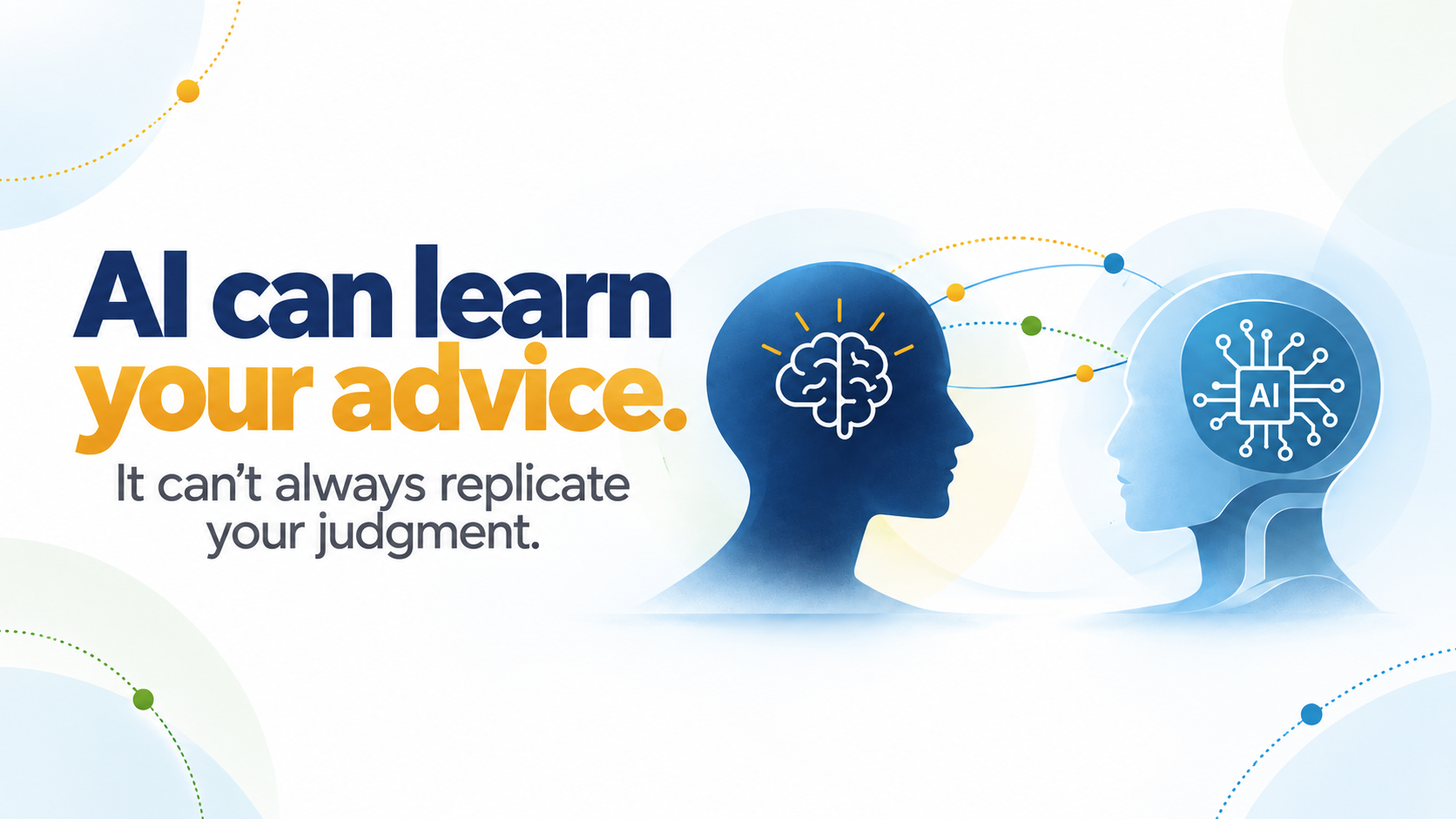
That becomes especially interesting as AI gets better at absorbing enormous amounts of what we’ve written, taught, recorded, and shared.
AI Could Know a Lot About How I Think
At this point, I could feed AI more than 20 years of my work.
Articles. Trainings. Newsletters. Books. Client materials. Frameworks. Workshops.
It could learn how I think about client experience, systems, leverage, marketing, operations, decision-making, profitability, Trust Leaks™, Extreme Client Care™, and a long list of other topics.
If you asked it, “What would Sandy do?” I suspect it could give you a pretty good answer much of the time.
Then there would be the situations where one detail changes everything.
That’s where experience shows up.
Sometimes the right recommendation is the one I’ve given dozens of times before.
Sometimes my response is, “Normally I’d recommend X. Given what you just told me, I wouldn’t do that here.”
This Is Also an Owner Dependency Question
I’ve been spending a lot of time lately thinking about where businesses depend on their owners.
Some of those dependencies clearly need to change.
- The owner still approves routine decisions.
- Important information lives in her head.
- A process works only because she remembers to check on it.
- She is doing work someone else could own with the right authority, training, or system.
Those are the kinds of dependencies that quietly limit capacity and choice.
Then there are other places where the owner really does make the outcome better.
- Her judgment.
- Her relationships.
- Her reputation.
- Her creativity.
- Her ability to see connections other people don’t see.
- Her experience knowing when the normal answer isn’t the right answer.
I don’t think we should automatically remove the owner from those places.
The Question Isn’t Whether the Business Needs You
For years, business owners have heard some version of:
“Build a business that can run without you.”
I understand the intent behind that advice.
I think there is a better question.
Where should the business still need you?
Where does your involvement create value that is worth protecting?
And where has the business simply become dependent on you because no better structure has ever been created?
Those are not the same thing.
One may be a strategic dependency.
The other may be a vulnerable one.
Knowing the difference matters far more than trying to make yourself unnecessary everywhere.
That old WWSD Post-it makes even more sense to me now than it did when I first saw it.
My client wasn’t trying to make herself dependent on me. She was trying to strengthen her own judgment by borrowing mine when it was useful.
To me, that’s a much better goal than trying to remove the owner from every part of the business.
The real question is knowing when your involvement is creating value, and when it’s simply creating dependency.