
Your Business May Not Depend on You. One Part of It Might.
When people hear “owner-dependent business,” they often picture a company where everything stops if the owner walks away.
That certainly exists.
It is not what I see most often.
An established business can have a capable team, good systems, happy clients, strong revenue, and still depend heavily on the owner in one or two very specific places.
That is part of what makes owner dependency easy to miss.
The Business Can Be Strong and Still Have a Dependency
Maybe your delivery team can serve clients beautifully without you.
Then a large sales opportunity appears, and suddenly everyone is waiting for you to step in and close it.
Or perhaps sales are no longer dependent on you at all. Leads are coming in, someone else handles the conversations, and the process works.
Yet meaningful decisions still make their way back to your desk.
You may have solid systems and capable people, while every exception, judgment call, or unusual problem eventually becomes yours.
And then there are relationships.
A business can look very independent until you realize that the largest clients, best referral partners, or most important strategic relationships are connected primarily to the owner rather than the company.
None of those examples means the entire business is owner-dependent.
They mean there is a dependency somewhere inside it.
Six Places I Look
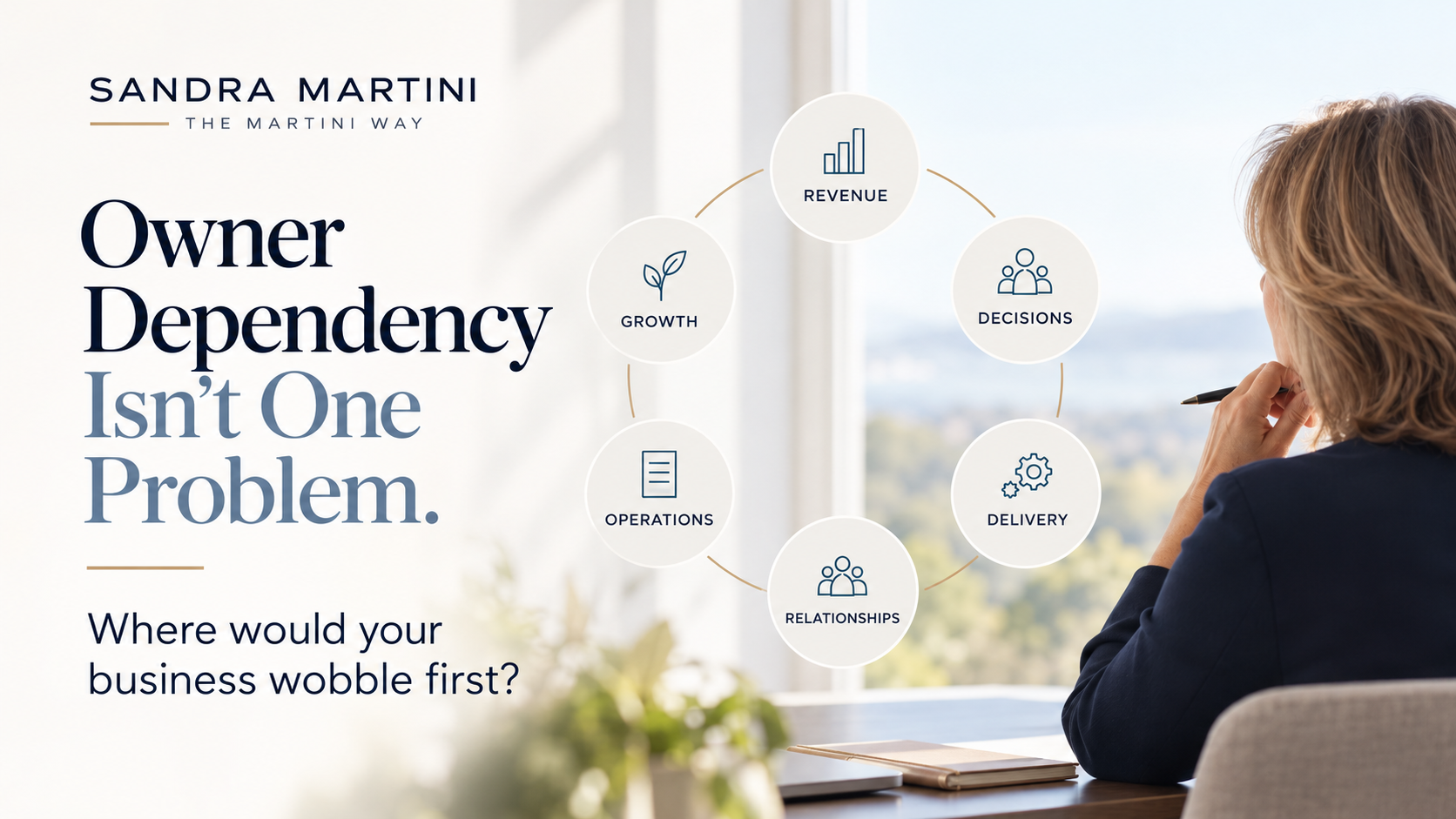
I have been looking at owner dependency across six areas:
Revenue
How much of bringing in, closing, retaining, or renewing business still requires the owner?
If you stopped selling, networking, nurturing relationships, or promoting the business for a while, what would happen?
Decisions
How much work pauses because someone needs your approval, judgment, or context?
Can your team make meaningful decisions confidently without you, or does uncertainty eventually travel upward?
Delivery
How much of the actual client result still depends on your direct involvement?
If sales increased significantly, would your personal workload increase right along with them?
Relationships
Who really owns the important relationships?
Would your clients, partners, vendors, and referral sources remain just as connected to the company if you became less involved?
Operations
What continues to work because you remember, notice, check, prompt, or fix?
Sometimes the owner is still the invisible operating system even when there are plenty of documented processes.
Growth
What happens to marketing, innovation, strategic projects, and new ideas when you become busy elsewhere?
Does growth have momentum of its own, or does it wait for you?
Try the Two-Week Question
There is a simple way to start seeing the pattern.
Ask yourself:
If I were unexpectedly unavailable for two weeks, what would wobble first?
I deliberately use the word wobble.
I am not asking what would completely collapse.
What would slow down?
What would become harder?
What would lose momentum?
Where would people start creating workarounds?
Where would someone say, “We really need her for this”?
That gives you a much clearer place to look.
Your Highest-Dependency Area May Not Be the Problem
This is where the conversation gets more interesting.
The area with the greatest owner dependency may not be the area that needs to change.
You may love being involved there.
Your judgment may improve the outcome.
Your relationships may genuinely create value.
Your reputation may be one of the reasons clients choose the company.
In that case, the dependency deserves a closer look before anyone starts trying to eliminate it.
Then there may be another area with a lower level of dependency that you no longer want to own at all.
Perhaps you still approve routine decisions because that is how the company evolved.
Perhaps you remain involved in delivery because no one ever redesigned your role.
Perhaps a process still depends on your memory because it has never been moved into a system.
Those dependencies feel very different.
Start With the Pattern
I would not start by asking:
Is my business owner-dependent?
That question is too broad to be particularly useful.
I would ask:
Where does my business depend on me most?
Then:
Do I still want it to?
Those two answers give you a much better starting point for deciding what stays, what changes, and where your involvement is still worth protecting.