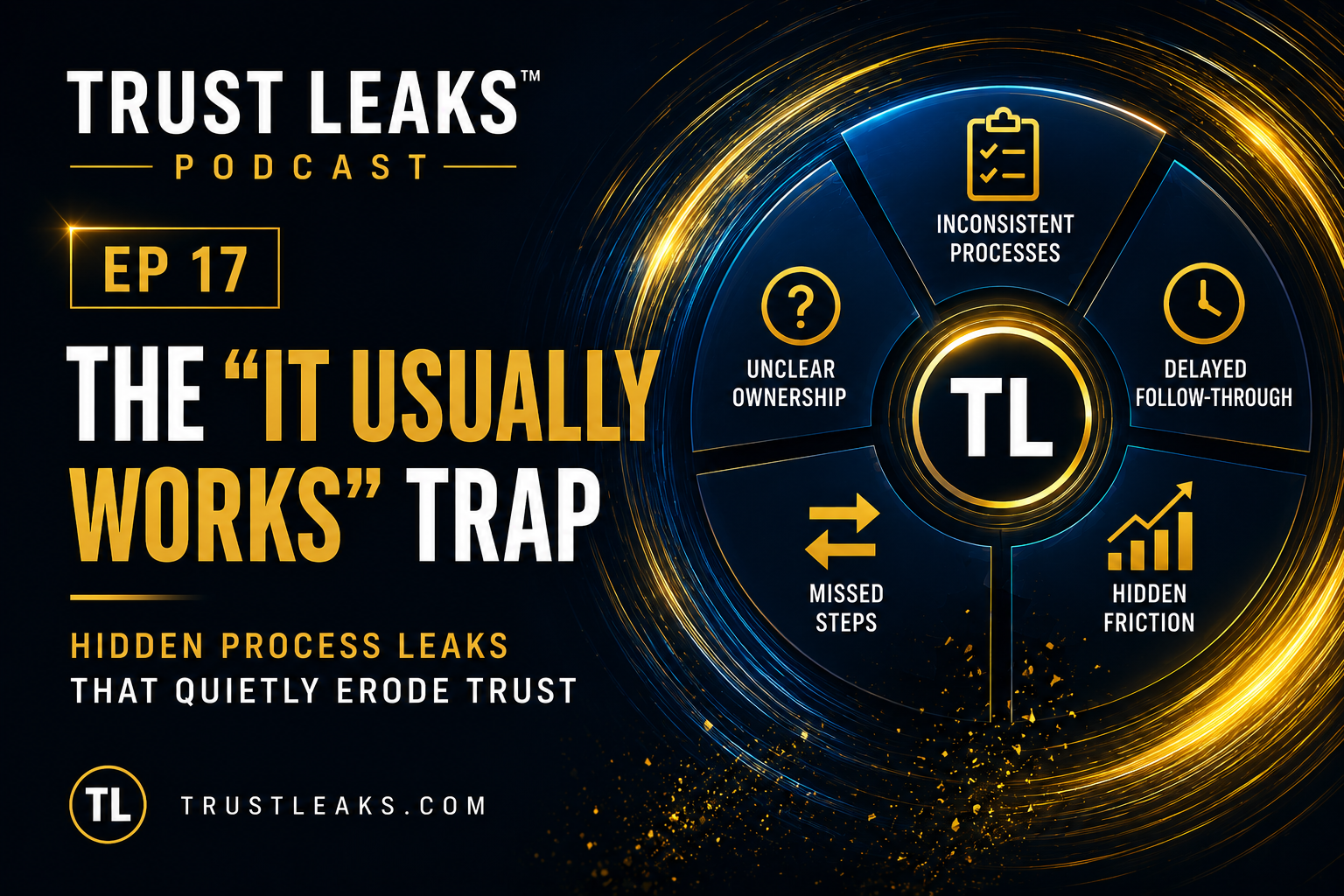
Most business owners do not realize they have a process problem because, technically, the process “works.”
Most of the time.
And that phrase alone is often the warning sign.
One of the most dangerous operational patterns inside growing businesses is what I call the “It Usually Works” trap.
It sounds harmless at first:
• “This normally works.”
• “We’ve never had an issue before.”
• “That rarely happens.”
• “It works nine times out of ten.”
But hidden inside those statements is often a Trust Leak™.
Because trust is built on predictability, reliability, and repeatability. When systems only function under ideal conditions, trust quietly begins to erode long before the business notices a major problem.
This shows up constantly inside client experiences, onboarding, communication systems, and internal operations.
A client misses an email.
A follow-up gets delayed.
A task falls between team members.
A customer has to ask twice for something that should have happened automatically.
Individually, these moments may seem small.
Collectively, they create friction.
And friction changes how clients experience your business.
One of the biggest reasons this happens is because many businesses rely on conditional processes. These are systems that only work under certain circumstances:
• when a specific employee is available
• when the timeline is ideal
• when the client behaves a certain way
• when everyone remembers every step
The problem is that businesses grow. Teams change. Clients vary. Real life interrupts systems constantly.
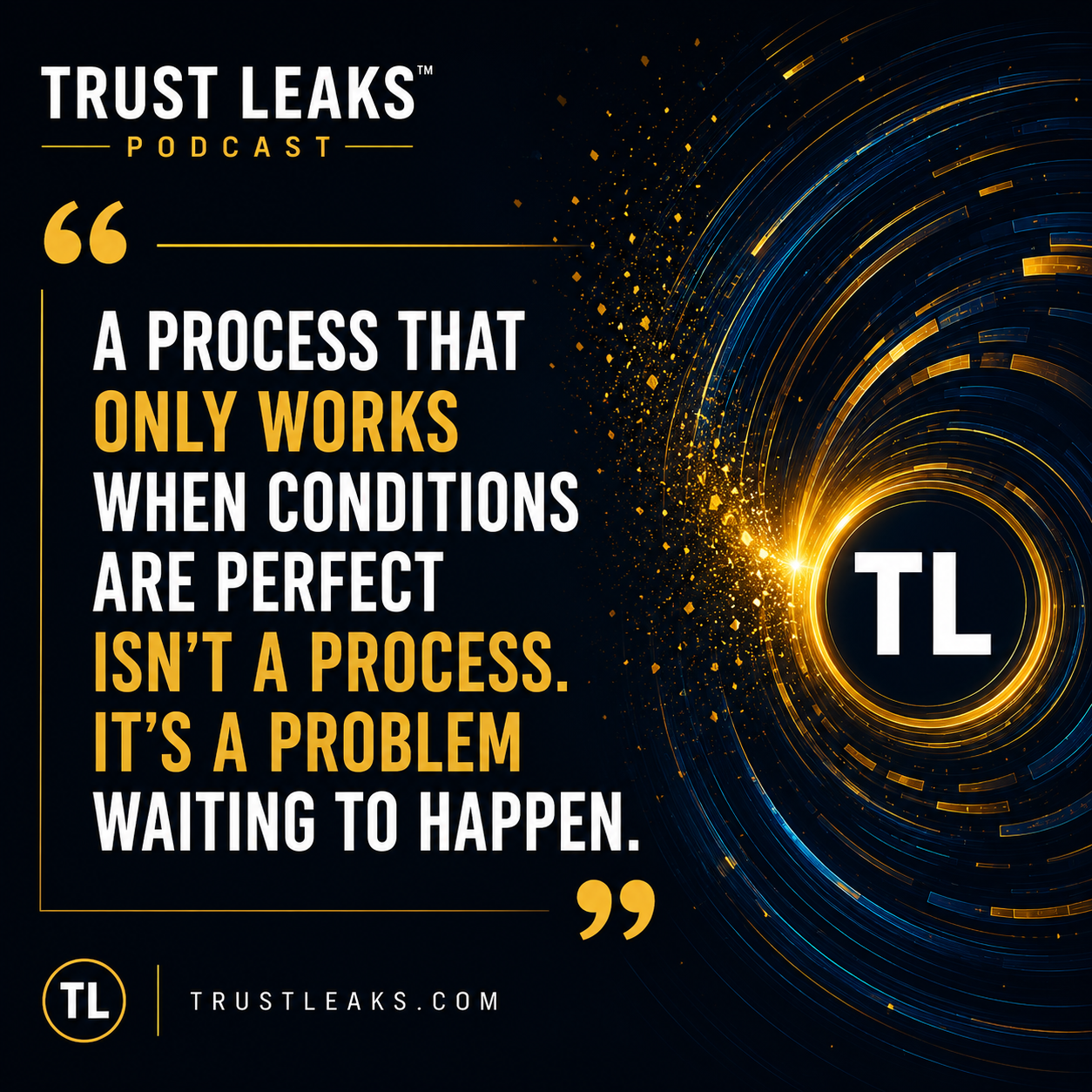
A process that only works under perfect conditions is not actually stable.
Another common issue is memory-dependent systems.
These are processes that rely on people remembering details instead of relying on documented systems, automation, visibility, or structured workflows.
You hear things like:
• “Don’t forget to send that.”
• “Normally we also do this.”
• “Make sure you remember that extra step.”
If the system depends on memory, it is fragile.
And once one small piece is forgotten, the entire client experience can shift.
This is where businesses often begin compensating behind the scenes. Team members jump in to save situations manually. Leaders quietly patch problems. Employees work harder to protect the customer experience.
From the outside, the business still appears functional.
Internally, however, the team is constantly compensating for unstable systems.
That compensation creates exhaustion, inconsistency, and eventually larger operational breakdowns.
This also connects directly to Episode 14 of Trust Leaks™:
“Process Leaks: When the Work Moves but the System Doesn’t.”
In that episode, we explored how activity can create the illusion of progress while outcomes quietly deteriorate underneath the surface. Episode 17 expands on that concept by examining why unstable processes often survive longer than they should — because they “usually work.”
The solution is not perfection.
The solution is visibility.
Start identifying the areas where your business relies on:
• memory instead of systems
• assumptions instead of clarity
• heroics instead of repeatability
• workarounds instead of stable processes
Then ask a simple question:
“If this specific person disappeared for one week, would this process still work consistently?”
That question alone exposes more operational risk than most businesses realize.
Healthy systems should protect trust automatically.
Because when processes are reliable, clients feel confident.
Teams feel calmer.
Communication becomes clearer.
And growth becomes easier to sustain.
If your business feels harder to operate than it should, hidden process leaks may already be affecting your client experience.
The good news?
Once you can see them, you can begin fixing them deliberately.
Listen to the Full Episode
To hear the full discussion, listen to Trust Leaks™️ Podcast – Episode 17: Your Process Looks Fine… So Why Is It Breaking? on Apple, Spotify or YouTube.