
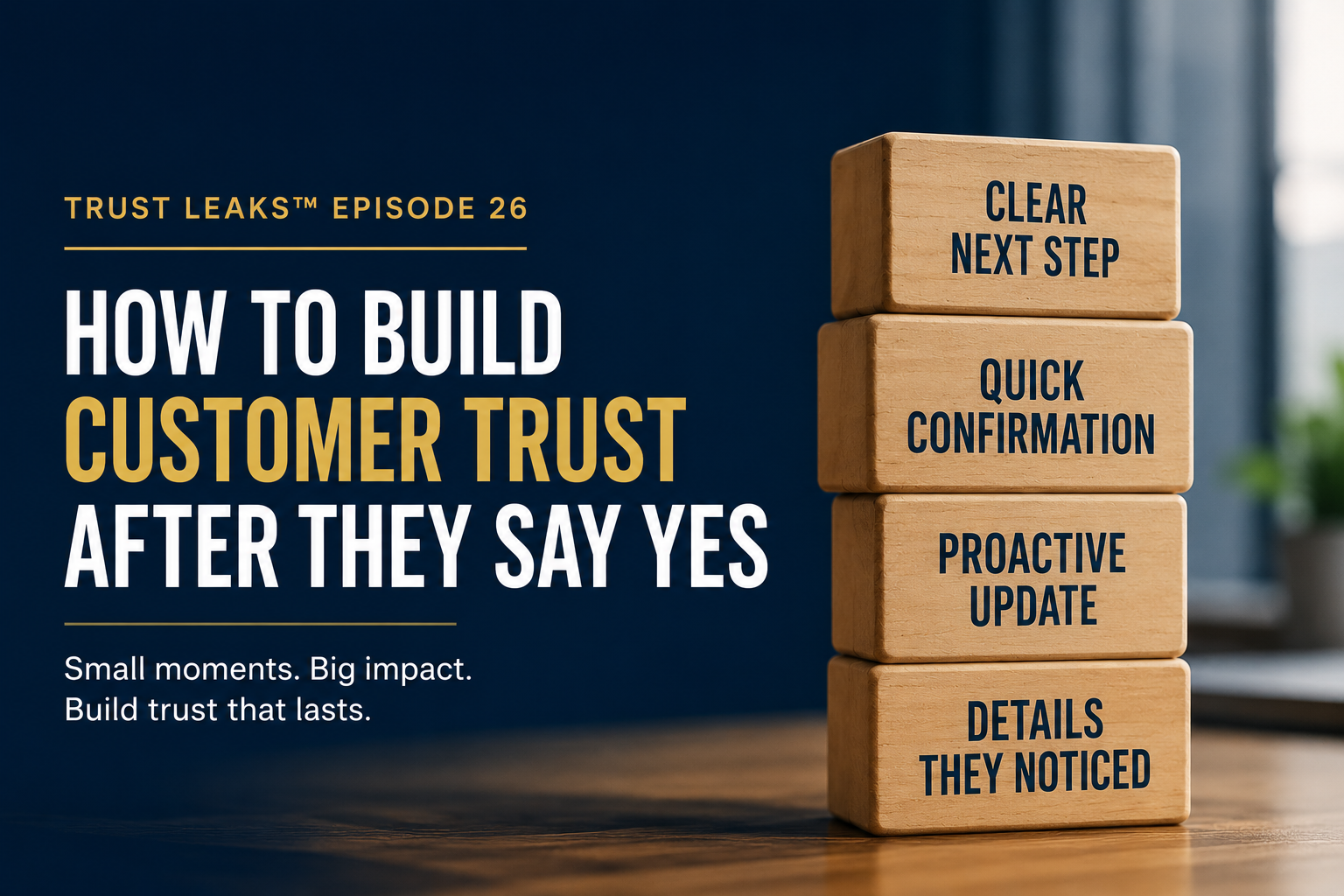
Most businesses know they need to build customer trust.
They focus on delivering good work, keeping promises, communicating well, and creating a positive customer experience.
All of that matters.
What is often missed is that customer trust is not built only when you deliver the final result.
It is built through a series of smaller moments that happen throughout the relationship, including moments that occur immediately after someone decides to work with you.
I call these trust deposits.
A trust deposit is something your business does that gives a customer another reason to believe:
- I made the right decision.
- They know I’m here.
- They’re paying attention.
- I know what happens next.
- I’m in capable hands.
Individually, many trust deposits seem small.
Together, they shape how someone experiences your business.
What Is a Trust Deposit?
A trust deposit is an action, communication, or experience that increases a customer’s confidence in your business.
It does not need to be elaborate or expensive.
- A confirmation email can be a trust deposit.
- A clearly explained next step can be a trust deposit.
- Remembering something important a customer told you can be a trust deposit.
- Contacting someone before they need to ask for an update can be a trust deposit.
- Telling a customer about a delay before the promised deadline can be a trust deposit.
Each one provides evidence that your business is organized, attentive, reliable, and worthy of continued trust.
And one of the most important opportunities to make a trust deposit happens immediately after someone says yes.
Why Is the Moment After a Customer Says Yes So Important?
Think about what happens when someone buys from you, signs an agreement, schedules an appointment, registers for an event, or joins a program.
They have made a decision.
They may be excited.
They may also immediately start wondering:
- Did my payment go through?
- Did they receive my information?
- Who contacts me next?
- When will I hear from someone?
- Is there something I need to do?
- Did I make the right decision?
Excitement and uncertainty can exist at the same time.
That is why the customer experience immediately following the decision matters so much.
A strong initial experience answers those questions before the customer needs to ask them.
How Can Businesses Reduce Buyer’s Remorse?
One of the simplest ways to reduce buyer’s remorse is to acknowledge the decision immediately and explain exactly what happens next.
A generic message saying:
“Thanks. Someone will be in touch soon.”
does very little to reduce uncertainty.
A stronger message tells the customer:
- Who will contact them.
- How they will be contacted.
- When they should expect contact.
- Whether they need to do anything beforehand.
- What happens after that.
Even when nothing is required from the customer, tell them.
“You don’t need to do anything right now. Our team will contact you Thursday.”
That sentence removes a surprising amount of uncertainty.
Customers do not need to know every internal step in your process.
They do need enough information to understand where they are in it.
Why Does Clarity Build Customer Trust?
People are more comfortable when they know what is happening.
Confusion forces them to make assumptions.
And when someone has just invested money, time, or emotional energy into a decision, those assumptions can quickly turn negative.
Clear next steps reduce that mental load.
- If a customer needs to complete a form, give them one clear link.
- If they need to attend a meeting, confirm the date, time, and location.
- If your team is handling everything, tell them that too.
Do not make customers search through old emails, remember something briefly mentioned during a call, or figure out which system contains the information they need.
Making the next step easier is itself a trust deposit.
Do Welcome Gifts and Shock and Awe Packages Build Trust?
They can.
The important question is not how impressive the package looks.
The better question is:
Does this make the customer’s experience easier, more enjoyable, or more valuable?
One company that did this particularly well in my own experience was RYZE Superfoods.
I purchased mushroom coffee from them for the first time.
When the package arrived, it included the coffee along with instructions, a pre-measured wooden scoop, creamer samples, a stirrer, and a travel mug.
I had not even tasted the coffee yet.
They had already made using the product incredibly easy.
I did not need to figure out the measurement.
I did not need to find the right scoop.
I did not need instructions from somewhere else.
They had thought through the experience I was about to have and removed friction from it.
That package did more than contain promotional items.
It supported the reason I purchased in the first place.
That is a trust deposit.
When Can a Welcome Package Hurt the Customer Experience?
Sending more does not automatically create more trust.
A box filled with promotional merchandise may feel like marketing clutter.
An elaborate package arriving weeks after a customer has already begun working with you may feel disconnected.
An expensive gift may even create frustration if the customer is still waiting for something more important.
I recently requested information from a company because I was curious about an industry.
I expected a small guide or something relatively easy to consume.
Instead, I received a 225-page book plus three additional books.
The company’s intention was generous.
My experience was overwhelm.
I had gone from thinking, “I’d like to learn a little more about this,” to feeling as though I needed to set aside a week to consume everything they had sent.
The amount of material did not match where I was in the relationship.
That distinction matters.
Trust is not increased by how much you send. Trust increases when what you send supports the relationship and helps the person take the appropriate next step.
Why Should Businesses Show Customers That Progress Is Happening?
Another easy trust deposit is simply making progress visible.
Customers do not always need a major update.
Sometimes they only need evidence that something is happening.
Think about an online order.
- You place the order and receive a confirmation.
- Then you hear that the company is preparing it.
- Then you receive notice that it shipped.
- Then you receive tracking information.
None of those updates changes the product you purchased.
They change your experience while waiting for it.
The same principle applies to service businesses.
A quick message saying:
“We received everything and have started our review. Nothing is needed from you right now. We’ll update you again next Thursday.”
can prevent days of unnecessary uncertainty.
This connects directly with another Trust Leaks™ issue I explored in Why Clients Keep Checking In When Everything Is on Track.
Sometimes the work is progressing exactly as planned and the client still feels uncertain because that progress is invisible.
Trust deposits make the invisible visible.
How Does Listening Build Customer Trust?
One of the strongest trust deposits costs almost nothing.
- Show people that you listened.
- Use their name correctly.
- Remember why they came to you.
- Reference an important goal they shared.
- Avoid asking them to repeatedly provide information your company already has.
Years ago, I was choosing between two builders for a new home.
I actually preferred one company’s home design and their pricing was slightly better.
After several conversations, they still could not get my name right.
They used the wrong name in person; They used the wrong name in text messages.
Eventually, that seemingly small detail affected my decision.
If a company could not reliably manage something as basic as my name after several conversations, I was not comfortable trusting them with the thousands of details involved in building my home.
Small details become signals.
When your team remembers and uses information a customer has shared, you communicate:
- We were listening.
- You matter beyond the transaction.
- We understand what you are trying to accomplish.
That is a meaningful trust deposit.
Can Telling a Customer Bad News Actually Build Trust?
Yes.
Trust can increase when a company communicates honestly before circumstances force the conversation.
- If you made a mistake, own it.
- If a deadline is going to move, tell the customer before the deadline passes.
- If you do not know the answer to a question, say so and explain when you will get the answer.
Businesses sometimes delay difficult conversations because they fear losing trust.
The delay often causes more damage than the original problem.
Early communication tells the customer:
- We are not hiding from this.
- We are paying attention.
- We respect you enough to keep you informed.
- You will hear important information from us rather than discovering it yourself.
The customer may still be disappointed.
They can also come away with greater confidence in how your company handles problems.
How Do You Build Customer Trust Over Time?
Customer trust rarely comes from one grand gesture.
It grows through repeated evidence.
- A clear welcome.
- An immediate confirmation.
- An obvious next step.
- A thoughtful onboarding experience.
- A proactive update.
- A remembered detail.
- An honestly communicated problem.
Each one is a trust deposit.
And they stack.
- Trust deposit.
- Trust deposit.
- Trust deposit.
Over time, those small experiences reinforce someone’s decision to continue doing business with you.
Where Should You Look for Trust-Building Opportunities?
Start at the beginning of your customer experience.
And remember, “the beginning” may happen before someone becomes a paying customer.
It could begin when they:
- Download something from your website.
- Book a consultation.
- Register for an event.
- Complete an application.
- Request information.
- Join your email list.
- Make a purchase.
- Sign an agreement.
Then ask:
What happens immediately after they say yes?
- What do they receive?
- What do they know?
- What have you told them?
- What are they likely wondering?
- Where could uncertainty creep in?
And what could you do at that moment to make trust easier for them to give you?
Those questions can reveal some of the simplest opportunities to improve your customer experience.
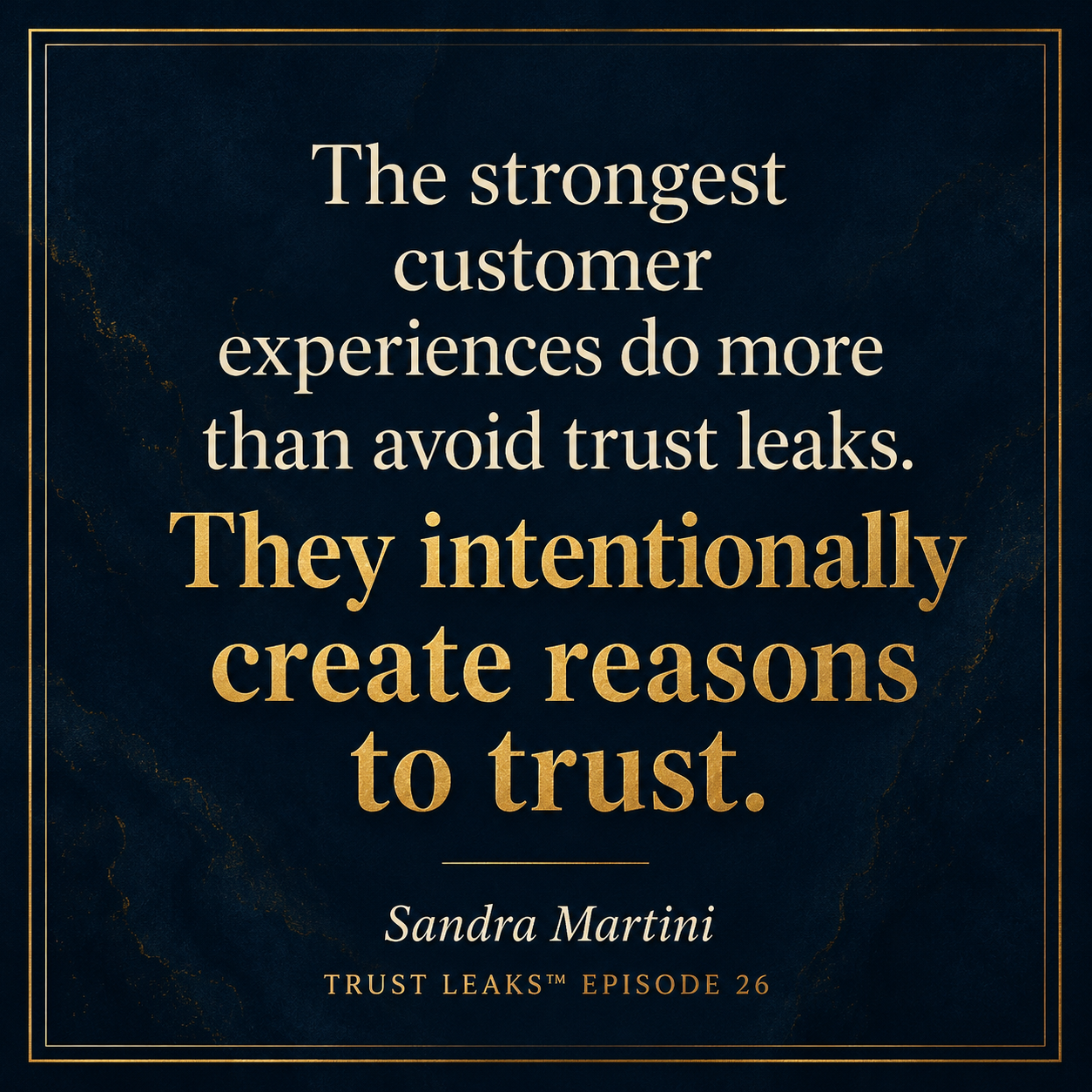
Because the strongest businesses do more than prevent trust from leaking away.
They intentionally give people reasons to trust them.
Listen to Trust Leaks™ Episode 26
In Episode 26 of the Trust Leaks™ Podcast, I go deeper into trust deposits, customer onboarding, welcome experiences, proactive communication, and the small moments that can strengthen or weaken a customer’s confidence in your business.
Listen on your favorite podcast platform or watch the full episode on YouTube.
Where Is Trust Leaking in Your Business?
Small customer experience and operational breakdowns can quietly affect trust, loyalty, referrals, and revenue long before they become obvious problems.
Take the complimentary Trust Leaks™ Diagnostic at TrustLeaks.com to identify where trust may be weakening inside your business.