Automation is supposed to make business easier. It can speed up responses, keep follow-up consistent, send reminders, confirm next steps, and reduce the chance that something falls through the cracks.
Yet customer-facing automation can also make a business harder to trust.
The issue usually is not the technology itself. The issue is what the automated experience communicates to the person on the other side.
Efficiency and Trust Are Not the Same Thing
A business can save ten minutes internally while adding three extra steps for the customer. A system can send every message on time and still leave someone wondering whether anyone actually knows who they are.
Efficiency asks: How quickly and consistently can we complete this process?
Trust asks: Does the customer feel confident that the process is working for them?
Strong automation should answer yes to both.
Five Ways Automation Quietly Creates Trust Leaks
1. Customers Cannot Tell Whether a Person Is Involved
An instant confirmation can be reassuring when it explains what happens next. Problems begin when automated messages create the appearance of attention without showing ownership.
Customers do not always need an immediate human response. They do need to know whether someone will become involved, when that will happen, and what to do if it does not.
2. Your System Makes People Repeat Themselves
Few things communicate “we are not paying attention” faster than asking someone for information they already provided.
A prospect completes a detailed form and receives an email asking for the same details. A customer explains a problem to a chatbot and then has to start over with a person.
Every repetition creates a small question: If they lost this information, what else might they lose?
3. Automation Creates Promises You Cannot Reliably Keep
System-generated confirmations feel official.
If an email says you will respond within 24 hours, customers expect a response within 24 hours. If a booking system confirms an appointment, they expect that appointment to exist. If an order confirmation says an item is being prepared, they expect it to be available.
To the customer, your automation is not separate from your business. It represents your business.
4. There Is No Clear Path to a Human
Automation works beautifully when everything follows the expected path.
Trust is often tested when it does not.
A good system should recognize when the standard process is no longer enough and provide a simple escalation path to someone who can understand the exception, use judgment, and take responsibility.
5. Personalization Feels Pretend
Using someone’s first name is not the same as recognizing the relationship.
Sending sales emails for something a customer already purchased, welcoming a five-year client as if they are brand new, or continuing a sequence after someone has said no can make personalization feel less personal.
Accuracy matters more than the appearance of personalization.
Use the Five-Question Automation Trust Test
Before automating any customer-facing process, ask:
- Does this make the next step clearer?
- Does this reduce work for the customer?
- Is the information accurate?
- Is ownership visible?
- Is there a clear path when automation is not enough?
If one of those answers is no, the system may be creating efficiency while also creating a trust leak.
This connects directly to the idea of trust deposits I explored in Trust Leaks™ Episode 26. Automation can create those deposits when it reduces uncertainty, makes progress visible, and helps people feel confident about what happens next.
The goal is not to make automation look human.
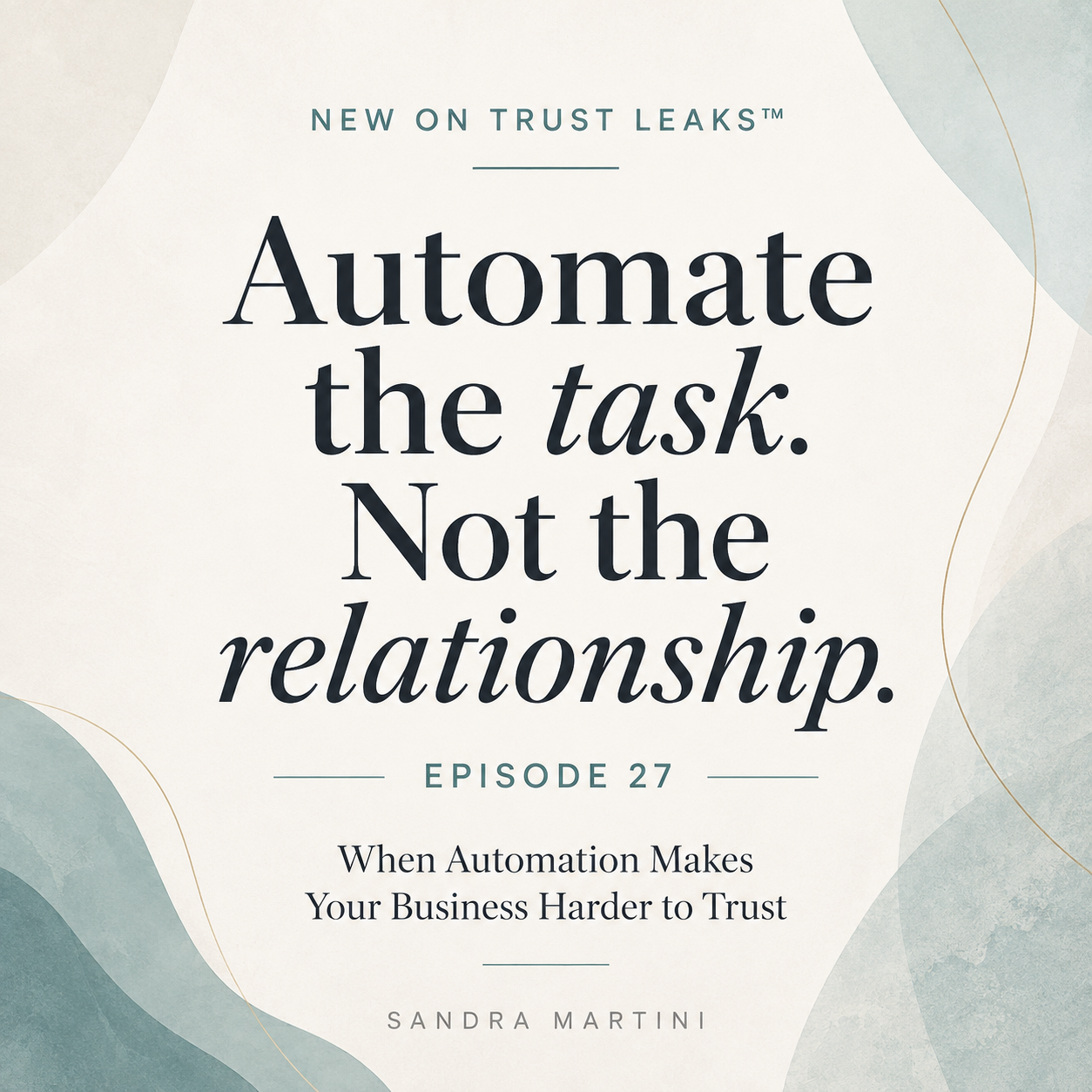
The goal is to automate the task without automating away the relationship.
Choose one automated customer experience in your business this week: a contact form, booking sequence, onboarding email, chatbot, reminder, or follow-up campaign. Walk through it as if you were the customer.
Do you know what is happening? What happens next? When a real person becomes involved? What to do when your situation does not fit the system?
Automation should make your business easier to trust, not merely easier to run.
Listen to the Full Episode
To hear the full discussion, listen to Trust Leaks™️ Podcast – Episode 27: When Automation Makes Your Business Harder to Trust on Apple, Spotify or YouTube.