Hiring a vendor, contractor, software provider, or outside service partner is supposed to make life easier.
You bring them in because your team needs help. You need capacity. You need expertise. You need something off your plate.
And then, sometimes, instead of relief, you start seeing little trust leaks.
Not giant failures at first. Small ones.
The copy comes back with the owner’s name wrong.
The ads are placed under the wrong account.
The core system is referenced incorrectly.
A simple yes-or-no question takes multiple follow-ups to answer.
The vendor moves quickly, yet clearly has not taken time to understand the business.
None of these moments may seem catastrophic on their own. Taken together, they start to tell a story.
That story is where trust begins to leak.
What are vendor trust leaks?
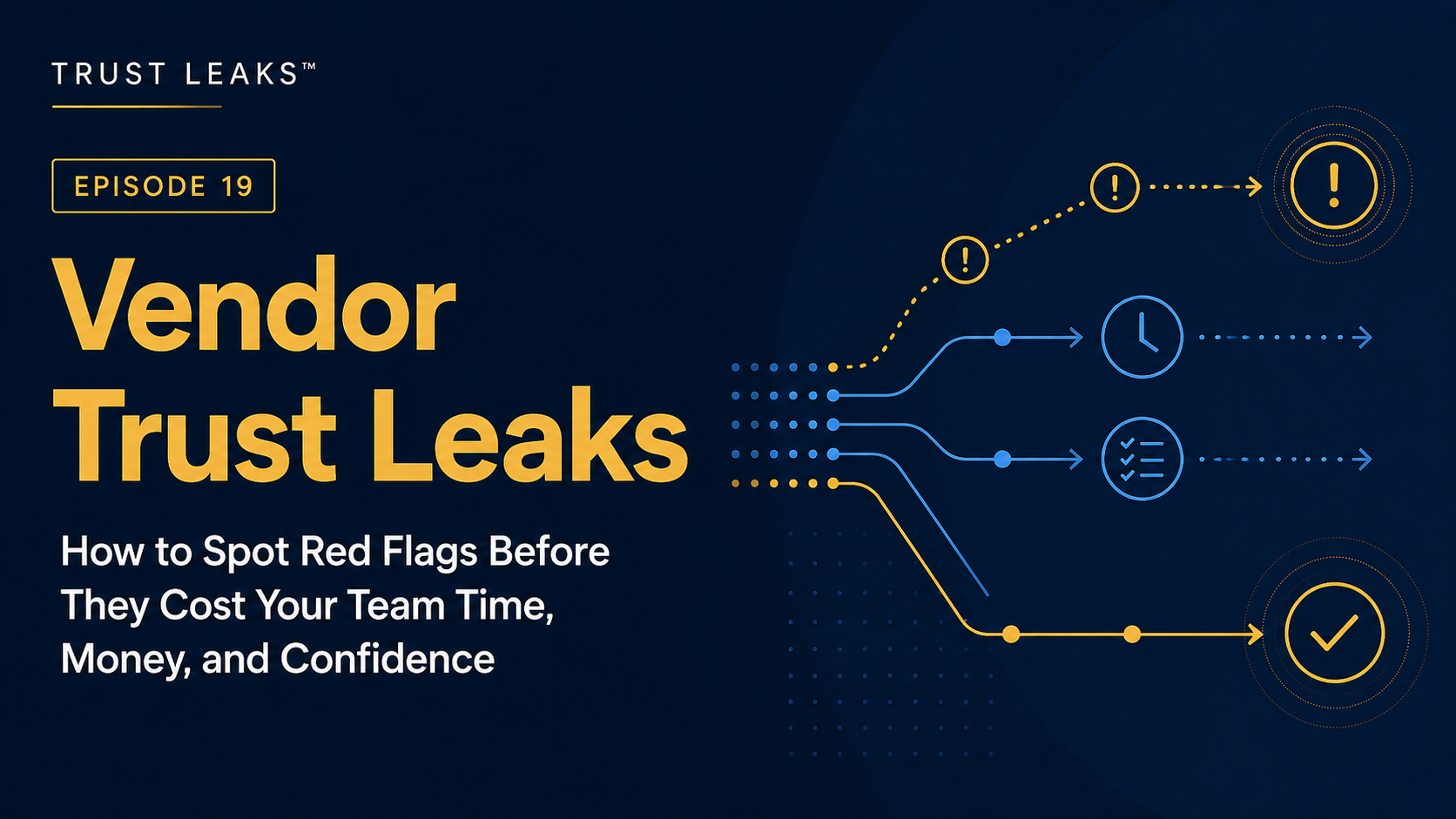
Vendor trust leaks are the small breakdowns in communication, follow-through, accuracy, expectation-setting, or care that cause a client or buyer to question whether a vendor can truly be relied on.
They often show up early in the relationship, especially during sales, onboarding, implementation, or the first few deliverables.
A vendor trust leak might look like:
- Missed details that should have been caught
- Delayed responses to simple questions
- Incorrect assumptions about your business
- Poor handoff between sales and delivery
- Repeated need for you to clarify the same information
- Work that creates more rework for your team
- Lack of proactive communication when something changes
The issue is not always that a mistake happened. Mistakes happen in every business.
The bigger question is: what does the pattern tell you?
A dropped ball is different from a red flag
One dropped ball does not automatically mean the vendor is the wrong fit.
Someone can miss a detail, misunderstand a point, or need clarification. That is normal.
A red flag appears when the dropped balls start stacking up.
When the copy is wrong, the setup is wrong, the strategy is misunderstood, and the communication is reactive instead of proactive, you are no longer dealing with a simple mistake. You may be looking at a deeper trust issue.
That is when it is time to pause and ask:
- Is this mistake understandable?
- Is this mistake preventable?
- Is this part of a larger pattern?
- Is this creating more work for the team we were trying to support?
- Is this vendor showing signs they understand our business?
- Are we seeing what it will actually be like to work together?
Those questions matter because early behavior is often a preview.

The sales process is part of the trust test
Trust leaks do not only happen after you hire someone.
They can happen before the contract is signed.
For example, imagine you are evaluating a software provider. The demo goes well. The platform looks promising. Your team asks one clear question.
The sales rep does the right thing at first and says, “I don’t know. Let me check.”
That response can build trust.
Then several days pass. No answer.
You follow up. Still no answer.
You follow up again. Eventually, the answer comes back: no, the software cannot do that.
The answer itself may not be the issue. The delay is.
A simple unanswered question can make a potential buyer wonder: if this is how communication works before we become a customer, what happens after we sign?
That is a vendor trust leak.
Trust leaks can also become trust builders
The opposite is also true.
A business can build trust quickly when it communicates clearly and sets expectations before frustration has a chance to grow.
Think about a restaurant server who tells you upfront that the kitchen is backed up because a large party just ordered.
Without that heads-up, you may sit there wondering where your food is.
With the heads-up, the experience changes.
You understand the wait. You can order appetizers. You can relax into the conversation. And if the server keeps your drinks full, checks in, and takes care of what is within their control, the delay may not damage trust at all.
It may build it.
That is the important lesson: trust is not built only when everything goes perfectly.
Trust is often built when something is imperfect and the business communicates well.
How to evaluate a vendor before moving forward
Before hiring or continuing with a vendor, contractor, or software provider, look for the trust signals.
Ask yourself:
- Do they listen carefully?
- Do they understand the context of your business?
- Do they follow through when they say they will?
- Do they communicate delays before you have to chase them?
- Do they take ownership when something is wrong?
- Do they make your team’s life easier or harder?
- Do they show care in the details?
If the vendor is strong in these areas, you may have a trust builder.
If the vendor repeatedly misses these marks, you may have a trust leak that will become more expensive over time.
How this connects to experience leaks
This is closely connected to Episode 16 of Trust Leaks™, “Experience Leaks: The Hidden Breakdown Costing You Clients, Referrals, and Trust.”
Experience leaks happen when the client or customer experience does not match the promise. Vendor trust leaks are one version of that same issue.
When a vendor promises relief and creates confusion, that is an experience leak.
When a software company promises simplicity and makes communication difficult, that is an experience leak.
When a service provider moves fast without understanding the client’s business, that is an experience leak.
And when those experience leaks repeat, trust erodes.
The bottom line
Every vendor relationship carries clues.
The question is whether you are noticing them.
Small mistakes, delayed answers, vague communication, and repeated rework may be warning signs. Proactive updates, clear expectations, thoughtful follow-through, and attention to detail are trust builders.
Before you hire, renew, or continue investing in a vendor relationship, pause and ask:
Is this business building trust with us, or quietly leaking it?
That pause may save you and your team time, money, stress, and confidence.
Listen to the Full Episode
To hear the full discussion, listen to Trust Leaks™️ Podcast – Episode 19: The “Just Checking In” Leak: What Client Follow-Ups Reveal About Your Business on Apple, Spotify or YouTube.