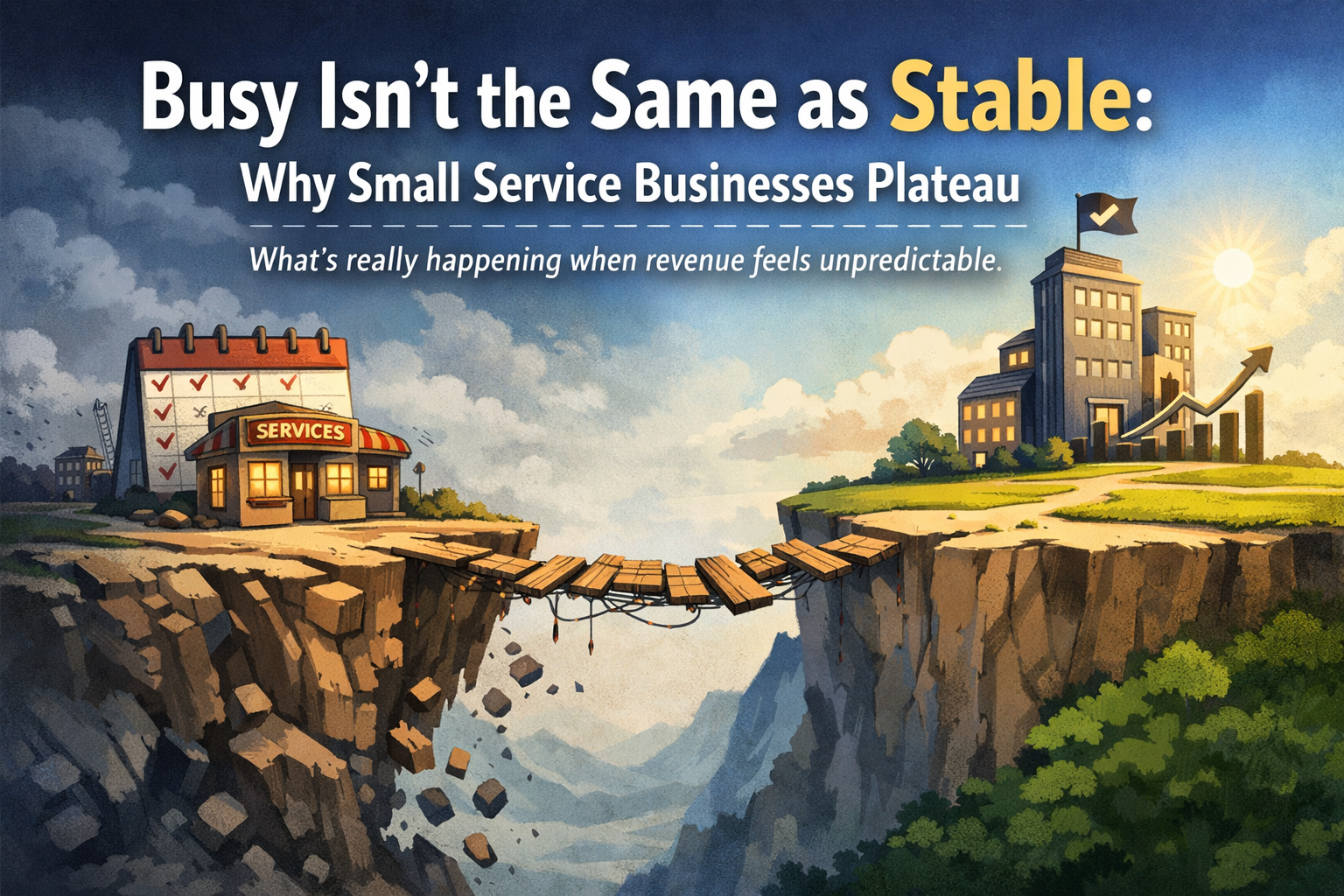
And the invisible gaps most service providers don’t realize are costing them revenue
You’re booked. You’re working hard. Clients seem happy.
And yet — your revenue still feels unpredictable.
For many service-based small business owners under $250,000 a year, this disconnect is confusing and exhausting. On paper, things look “fine.” In reality, the business feels fragile. One slow month, one client pause, or one personal disruption can throw everything off.
This usually isn’t a marketing problem.
And it’s rarely a talent problem.
It’s a structural trust problem.
Busy hides instability
When you’re busy delivering client work, it’s easy to assume momentum equals stability. But busyness often masks the absence of systems that quietly support consistency — things like follow-up rhythms, client handoffs, expectation-setting, and post-project continuity.
Without those structures, every new engagement requires fresh effort. Nothing compounds. Revenue resets to zero more often than it should.
The invisible gaps most owners don’t see
Most service providers don’t intentionally create instability. It happens gradually, through small, unaddressed gaps such as:
- No defined client journey beyond the initial engagement
- Inconsistent communication during and after delivery
- No clear next-step path once work is completed
- Follow-up handled “when there’s time”
- Referrals left to chance instead of design
Individually, these gaps feel minor. Collectively, they quietly erode trust, confidence, and repeat business.
Why good work isn’t enough
Delivering quality service is essential — but it’s not sufficient on its own.
Clients decide whether to return, refer, or disengage based not just on outcomes, but on how supported, clear, and confident they felt throughout the experience. When those signals are inconsistent, trust weakens — even if the work itself was strong.
This is why many capable business owners feel stuck in a cycle of constant acquisition. They’re rebuilding trust from scratch with every new client.
Stability comes from intention, not hustle
A stable business isn’t built by doing more. It’s built by closing trust gaps — intentionally and consistently.
That means:
- Designing a clear client experience from start to finish
- Creating simple, repeatable follow-up systems
- Making the next step obvious before a project ends
- Ensuring clients never wonder what happens after “delivery”
These don’t require complex software or a big team. They require clarity, consistency, and ownership.
The shift that changes everything
When you stop measuring success by how busy you are — and start measuring how well trust carries forward — you create a business that feels calmer, stronger, and more predictable.
Not overnight. But sustainably.
And that’s the difference between a business that survives month to month and one that actually supports the life you’re trying to build.